
Calexico Directory Runs
Calexico's most firmly documented city directory collection is a regional Imperial Valley set. The National Archives identifies volumes for 1926, 1928, 1930, and 1933, and each volume includes Calexico among several communities. The FamilySearch catalog title also describes a buyers' guide and complete classified business directory. The publisher and imprint have not been verified from an official page, so they are not treated as settled facts here.
| Collection | Years | Where Held | Access |
|---|---|---|---|
| Imperial Valley city directories | 1926, 1928, 1930, 1933 | NARA directory inventory; FamilySearch catalog | Regional volumes; availability and page access vary |
| U.S. Census schedules for Calexico | 1910 through 1950 | NARA and 1950 Census | Names, relationships, ages, birthplaces, occupations, and enumeration clues |
| Calexico Chronicle | 1904 through 1998 title run | California Digital Newspaper Collection | OCR names, addresses, notices, obituaries, marriages, and school news |
| Sanborn fire-insurance maps | 1910 onward; later years need verification | Library of Congress and California libraries | Building footprints, uses, materials, blocks, and street names |
| Calexico research guide | Guide publication; item years vary | California State Library | Routes to maps, newspapers, photographs, books, and archival sources |
| Camarena local materials | Holdings not verified | Camarena Memorial Library, Calexico | Ask staff to check catalogs and vertical files |
The table separates the Calexico collection from the records that help interpret it. The census supplies household context, the Chronicle supplies dated local events, and Sanborn maps supply a building layer. None of those companions turns a directory volume into a current resident list. Years not shown should be treated as unverified rather than silently filled with assumptions.
NARA's Imperial Valley directory inventory is the source for the four Calexico-containing years listed above.
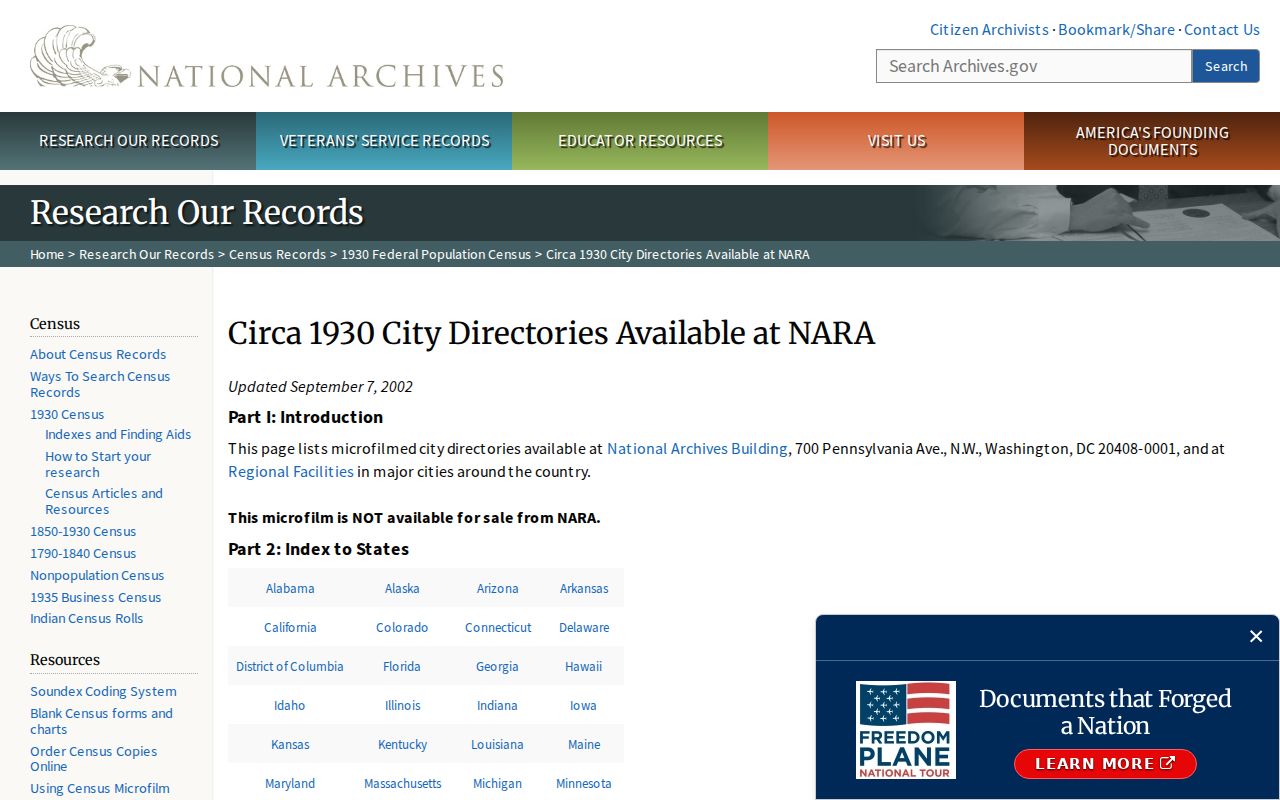
The NARA reference is useful because it confirms both the years and the regional scope before a researcher invests time in a page search.
Calexico's Valley-Wide Directory
A Calexico city directory search can return a volume that also names Brawley, Calipatria, El Centro, Heber, Holtville, Imperial, Niland, Seeley, and Westmorland. That ten-community span changes how a name or street entry should be read. A surname in the alphabetical section needs a town marker or address check before it is assigned to Calexico. A business in the classified pages may serve the whole valley, even when its listing is not a household clue.
Start with the front matter. It may explain abbreviations, town labels, the order of the sections, and the symbols used for householders or residents. Then compare an alphabetical name entry with any geographic or street section present in the same volume. The research record verifies the title components, but an actual page image was not available for a full field-by-field inspection. Do not promise that every year has a reverse section until the physical or digital volume confirms it.
The regional scope is a useful story in its own right. The directory reflects an agricultural and border economy that linked towns rather than treating Calexico as an isolated place. That makes neighboring communities helpful comparison points, but it also makes town markers essential evidence.
Note: A regional directory can place a Calexico family beside valley-wide business listings without making every classified address a Calexico residence.
Camarena's Calexico Research Desk
Camarena Memorial Library is the most local place to test what survives on the shelf. It is at 850 Encinas Avenue, Calexico, California 92231, with phone service at (760) 768-2170, fax at (760) 357-0404, and email at library@calexico.ca.gov. Posted hours are Monday through Thursday from noon to 7 p.m. and Friday from 10 a.m. to 6 p.m.; the library is closed on weekends. Those details make a call or email worthwhile before an in-person visit.
The library does not publish a holdings-level list that verifies Imperial Valley volumes, telephone books, Polk or R.L. Polk books, criss-cross books, Chronicle microfilm, yearbooks, or vertical files. Ask staff whether a Calexico city directory copy is shelved locally, then check the catalog for “Imperial Valley city directory,” “Calexico telephone directory,” “criss-cross directory,” “Calexico Chronicle,” and the exact school or yearbook title. A negative catalog result is a prompt to ask about uncataloged local files, not proof that no material exists.
The California State Library's California History resources provide a wider catalog and research route for maps, newspapers, photographs, books, and ephemera.
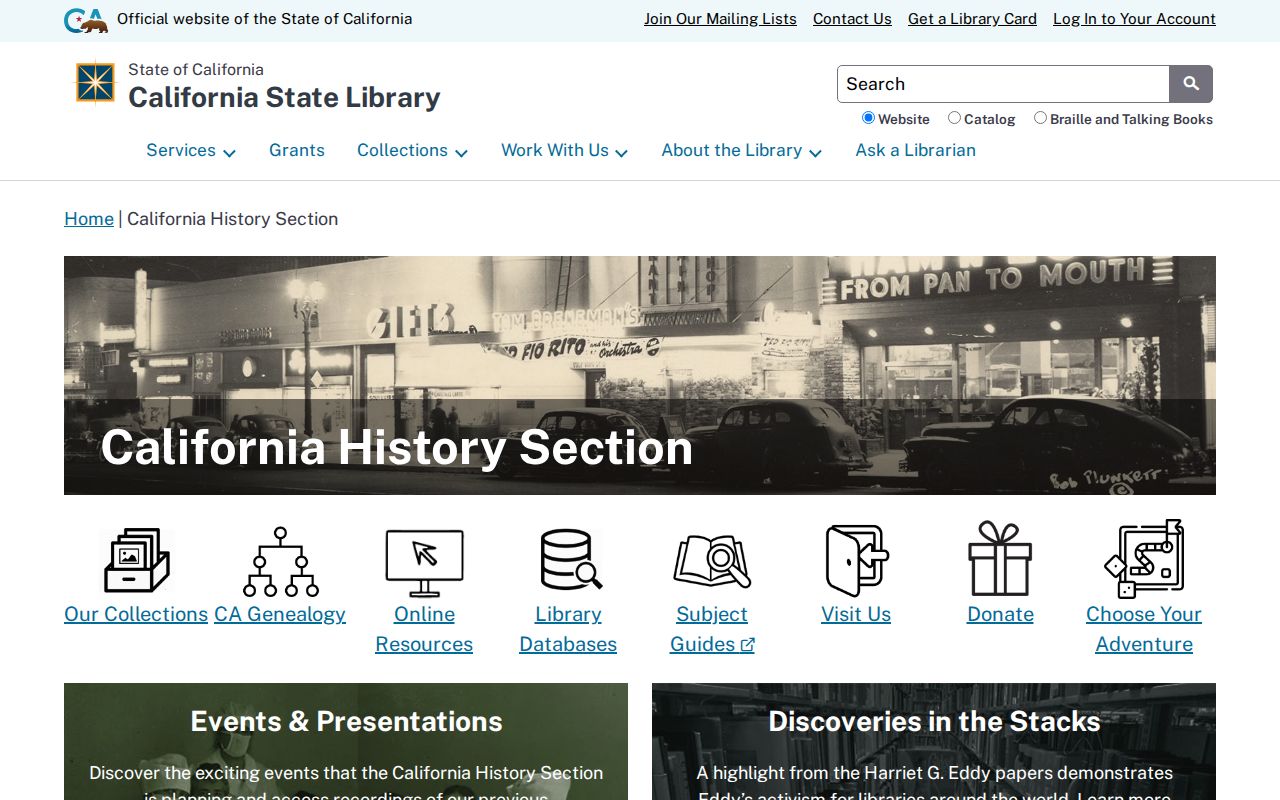
The State Library source complements Camarena's local check: one helps locate regional material, while the other can confirm whether a local copy, clipping file, or microfilm reel is available.
When a volume is held only in a reading room, record its title, year, call number, section order, and front-matter abbreviations before copying entries. Staff guidance can also reveal whether a school annual or local newspaper fills a gap between directory years.
How a Calexico Directory Entry Reads
A Calexico city directory entry is a compact notation system. The name may be surname first, with a spouse in parentheses. An occupation or employer abbreviation may follow, and a street address can anchor the person to a place at the time of publication. A mark such as “r” for resides or “h” for householder must be read against the volume's own key. The NARA description confirms the regional volumes and their directory components, but the exact symbols require inspection of the actual front matter.
| Name | Indexed surname and given name; a spouse may appear in parentheses. |
|---|---|
| Occupation | A trade or employer abbreviation may connect a person to local work or a business. |
| Address | House number and street, with a residence or householder mark when defined. |
| Owner or residence mark | A volume-specific owner, resident, or householder notation; the exact symbol must be checked in the front matter. |
| Family clue | Spouse, widow notation, or a related entry can suggest a household link. |
| Town marker | Calexico or another Imperial Valley community must be confirmed before assigning the entry. |
The entry inventory keeps a useful boundary in view. An occupation is a historical identifier, not proof of where a person lived. An address is a dated publication clue, not a current location. A business listing can name a proprietor or service address without describing the proprietor's household.
- Criss-cross directory
- A street-order or address-order index that works backward from a location to a listed occupant or business, if that section exists in the volume.
- Householder index
- A listing organized around the main household name or address; the exact meaning depends on the volume's instructions.
- Abbreviation key
- The front-matter legend that defines marks for residence, householder, widow status, occupations, town names, and other short forms.
- Town marker
- A label that separates Calexico from the other Imperial Valley communities included in the same regional book.
Photograph or transcribe the key before copying names. That small step prevents a familiar letter from being given a modern meaning and preserves the rules needed to compare two years.
NARA, Census, and Chronicle Clues
The federal census is the strongest companion to the regional directory because Calexico schedules are public from 1910 through 1950. The schedules can add names, relationships, ages, birthplaces, occupations, and address or enumeration clues. The 1950 search includes Imperial County geography and Calexico enumeration descriptions, so a page search can be narrowed by place as well as by surname.
The NARA 1950 Census search is the source shown here for the current federal access point.
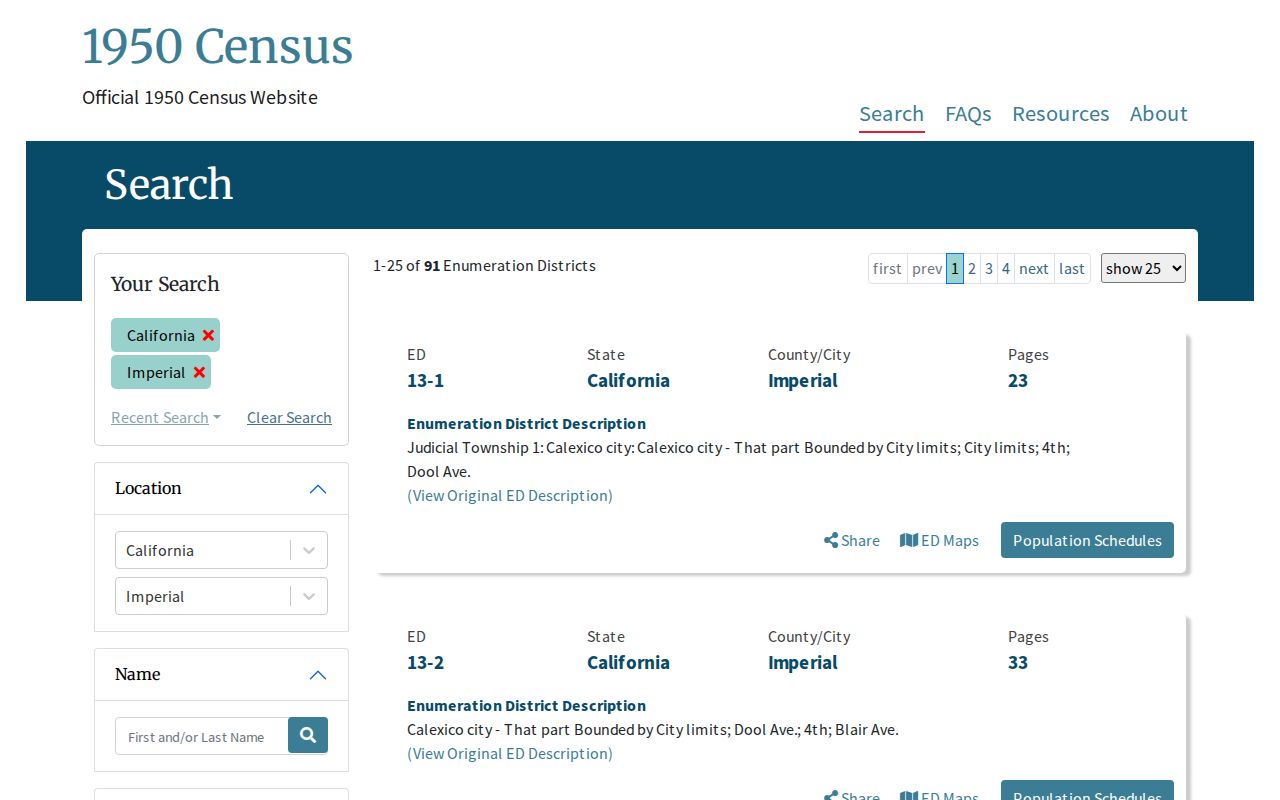
The census image helps anchor a household near the directory years. It does not replace the directory because the two records were created for different purposes and can use different spellings or address descriptions.
The Calexico Chronicle adds a local bridge between editions. Its reported title run spans 1904 through 1998 in the California Digital Newspaper Collection. OCR can surface names, addresses, notices, obituaries, marriages, school news, community events, and property advertisements. Always inspect the page image after an OCR hit, especially for Spanish compound surnames, accents, narrow columns, and worn microfilm.
Calexico Maps Add the Building Layer
Sanborn fire-insurance maps give a city directory search a physical setting. The Library of Congress collection includes Calexico material from 1910 onward, while later years need verification against the official year set. These maps show building footprints, use, construction materials, block numbers, and street names. They do not identify occupants, so a map footprint cannot be used as a substitute for a directory entry or census household. A city directory supplies the dated names that the map lacks.
Compare the map block and street name with the directory address. If a number seems out of place, preserve the lot, block, cross street, and parcel clues rather than forcing the old notation into a current format. A map can show that a structure existed or that a street label changed, while the directory supplies the dated person or business clue.
Use the Library of Congress Sanborn collection as a map starting point, then ask a California library whether local sheets or index pages provide a clearer year sequence.
Border Names in Calexico City Directories
Calexico's bilingual border setting makes name search a method choice, not a minor cleanup step. A person may use paternal and maternal surnames, omit one component in a U.S. entry, add a hyphen, Anglicize a given name, or appear under a spouse-related convention. Run both surname components, try accents removed, test initials, and compare the spouse or address only as corroboration.
OCR adds a second layer of risk. A mark in a Spanish surname may be dropped, a narrow column may merge two entries, and an old typeface may turn one letter into another. Search the Chronicle with variants, then inspect the page image. For the directory, read the front matter first and record the exact town marker. This is especially important when a regional book places Calexico beside nine other valley communities.
Directory absence is also ambiguous. A household may have moved, been missed by a canvass, used a different spelling, appeared only in a business section, or fallen outside the volume's publication scope. A census, newspaper item, and deed or probate clue can explain a gap without inventing a presence.
Trace Family History Through Calexico Volumes
The most useful Calexico volumes workflow treats each edition as one point on a timeline. The 1930 regional directory and the 1930 census overlap, while the 1926, 1928, and 1933 volumes bracket moves, household changes, and spelling shifts. Write down what the source says before trying to reconcile it with a later record.
- Choose a known name, address, or relative, then note every spelling and town label attached to the first promising entry.
- Check 1926, 1928, 1930, and 1933, recording spouse clues, occupation wording, street address, and any residence or householder mark.
- Pair the 1930 directory entry with the 1930 census, using household relationships and enumeration clues to test whether the same family is involved.
- Search the Calexico Chronicle for the address and name variants, then inspect notices, obituaries, marriages, school reports, and property items in the page images.
- Use Sanborn maps to check the block, building, street name, and structure context, without treating the map as an occupant source.
- For a present-day identity check, move to the relevant county custodian and compare dates instead of carrying an old directory address forward.
A directory clue that needs a modern record check belongs in a separate one-person workflow. The Calexico resident lookup page brings together county, court, vital, license, and business checks, while the historical volume remains the dated starting point.
A name that disappears after one issue is not an answer by itself. Test the next verified edition, search the Chronicle, and look for probate or an obituary before deciding whether the person moved, died, changed names, or was simply omitted.
A Calexico Directory Timeline
Calexico's record trail becomes clearer when publication dates are set beside local and federal milestones. The timeline below uses only dates documented in the research record. It does not invent a first or last directory year, and it does not claim a publisher change that has not been verified.
| Year | Record milestone | Why it matters |
|---|---|---|
| 1904 | Calexico Chronicle title run begins | Local newspaper context predates city incorporation. |
| 1907 | Imperial County created from eastern San Diego County | Earlier land and court trails may use predecessor custody. |
| 1908 | Calexico incorporated | Municipal records enter the city era. |
| 1926, 1928 | Verified Imperial Valley directory years | Regional snapshots before the census anchor. |
| 1930 | Verified directory and federal census overlap | Best point for correcting names and household links. |
| 1933 | Verified Imperial Valley directory year | Later bracket for a move or household change. |
| 1950 | Newest public census schedule in the cited set | Enumeration geography can help narrow Calexico pages. |
The Chronicle's long run and the four verified directory years give Calexico a useful bridge from local news to household records. The precise first and last publication years for the directory series remain unverified, so a researcher should ask NARA, FamilySearch, or Camarena about additional editions rather than infer a continuous run.
When a Calexico Directory Entry Is Missing
A missing line in a Calexico regional directory can reflect a missed canvass, rural delivery, a move, death, a new surname, an accent or OCR error, a town marker that was overlooked, or a volume that did not cover the expected section. It can also mean the person appeared only in the buyers' guide or classified business portion. The source's regional scope makes a careful section check more important than a quick name search.
Use the four verified years as a set, not as four yes-or-no tests. Pair the nearest volume with the census, search the Chronicle around the address, and use Sanborn maps to test the street context. If the trail predates the directory series, the California State Library guide and Camarena's catalog or vertical files can point to newspapers, school annuals, photographs, and other local material.
Research boundary. NARA verifies Calexico inside a multi-community Imperial Valley directory for 1926, 1928, 1930, and 1933. The publisher, complete annual run, and any reverse section still require volume-level confirmation.