
How Calexico Resident Searches Begin
A useful Calexico residents directory search begins with one known fact and moves toward a record that can support it. For a street address, the Imperial County Assessor can supply an APN, or assessor parcel number, and a map. The Clerk-Recorder can then connect that parcel to recorded instruments. For one person, the name index, court case search, vital-record rules, and business or license files answer different questions. Historical work takes a different path through the Calexico Chronicle, census schedules, and the Imperial Valley directory volumes.
No single roll lists every person in Calexico. Property data is about land and tax administration. A voter file is restricted and the state status tool is designed for a person checking their own registration. A deed names parties to an instrument, not everyone who uses a building. Directories are snapshots, and a missing name can reflect spelling, a move, a missed canvass, or the scope of the volume.
- Write down the name, address, date range, and the exact question. Keep the search narrow enough to compare results.
- Use ParcelQuest Lite for an APN or physical address when the trail begins with land. Save the legal description and map context.
- Search RecorderWorks by the recommended surname-first format, then narrow by date, document type, parcel, or map.
- Use court, vital, business, license, or election tools only for the purpose and access level each custodian allows.
- For an older household, pair the four verified directory years with census pages, Chronicle notices, and library or archive help.
Note: A name, address, and date make a stronger lead than a name alone, especially in Calexico’s bilingual records.
Calexico Resident Records Offices
Calexico is not the Imperial County seat. The city’s local files begin with City Hall and its departments, while the core county counters are in El Centro about 13 miles north. The county route covers recorded documents, assessment and parcel records, elections, vital certificates, and Superior Court files. That split explains why a Calexico person or parcel may appear in a portal whose name says Imperial County or El Centro.
Imperial County Clerk-Recorder
940 Main Street, Suite 202
El Centro, CA 92243-2865
(442) 265-1075
Imperial County Assessor
940 W. Main Street, Suite 115
El Centro, CA 92243
(442) 265-1300
Mapping/GIS: (442) 265-8609
Imperial County Elections
940 W. Main Street, Suite 206
El Centro, CA 92243-2839
(442) 265-1060
Imperial Superior Court
Public services for Calexico route through El Centro courthouses.
(760) 482-2200
The county records counters are the fallback when a portal does not show a needed year or copy. The assessor also accepts walk-in, mail, phone, fax, and email questions during Monday through Friday counter hours. The Clerk-Recorder offers free index and counter viewing, while copies and mailed orders cost money under the current schedule. A records request under the California Public Records Act can reach existing city or county records that are not posted, but it cannot require staff to make a new list.
Note: Route a city permit or code question to Calexico, but route a deed, assessment, court, election, or county certificate question to El Centro.
Calexico Residents: Five-Index Trail
When a search starts with a person, the strongest trail is a chain of small matches. RecorderWorks may show an indexed party to a deed, lien, map, probate-related instrument, or other document. That result can point to an APN or legal description. ParcelQuest Lite can connect the APN to a situs address and parcel map. A court record can add a case number and public filing history, while a business entity or professional license can add a public affiliation.
Use two independent attributes beside the name. A middle initial, spouse or associate in a recorded document, consistent city, APN, license number, age range, or repeated business link can separate two people with the same name. Search both parts of a Spanish compound surname, remove accents when an older database requires it, and try initials or alternate given names. A matching address is an association to investigate, not proof of a current home.
Calexico Name Records Since 1986
RecorderWorks is the most useful online name index in the Calexico search path. Its public index begins on January 2, 1986. Use the Name mode with LAST, FIRST syntax. The portal accepts a business name, supports a fraction such as smith, a, and offers an Allow Partial Match option. The office recommends adding part of a first name because a broad surname search can time out. A person’s name in the left menu can open a list of tied documents sorted by type and recording date.
The index also supports document number, document type with date range, recording date, parcel number, and map modes. A document number begins with a four-digit year. Search results expose indexed names, document type, recording date, and sometimes parcel details. Open the document number for detail, then use the cart or the counter when a copy is needed. Pre-1986 instruments are not absent from county history. Ask at 940 Main Street, Suite 202 for older grantor-grantee books, indexes, book and page references, or a legal-description search.
RecorderWorks can show a land or legal connection. It cannot turn every indexed party into a resident. A lender, trustee, attorney, beneficiary, heir, lien claimant, or business can appear without living at the Calexico parcel.
The Imperial County RecorderWorks index shows the search modes and the clickable name path used for post-1986 instruments.
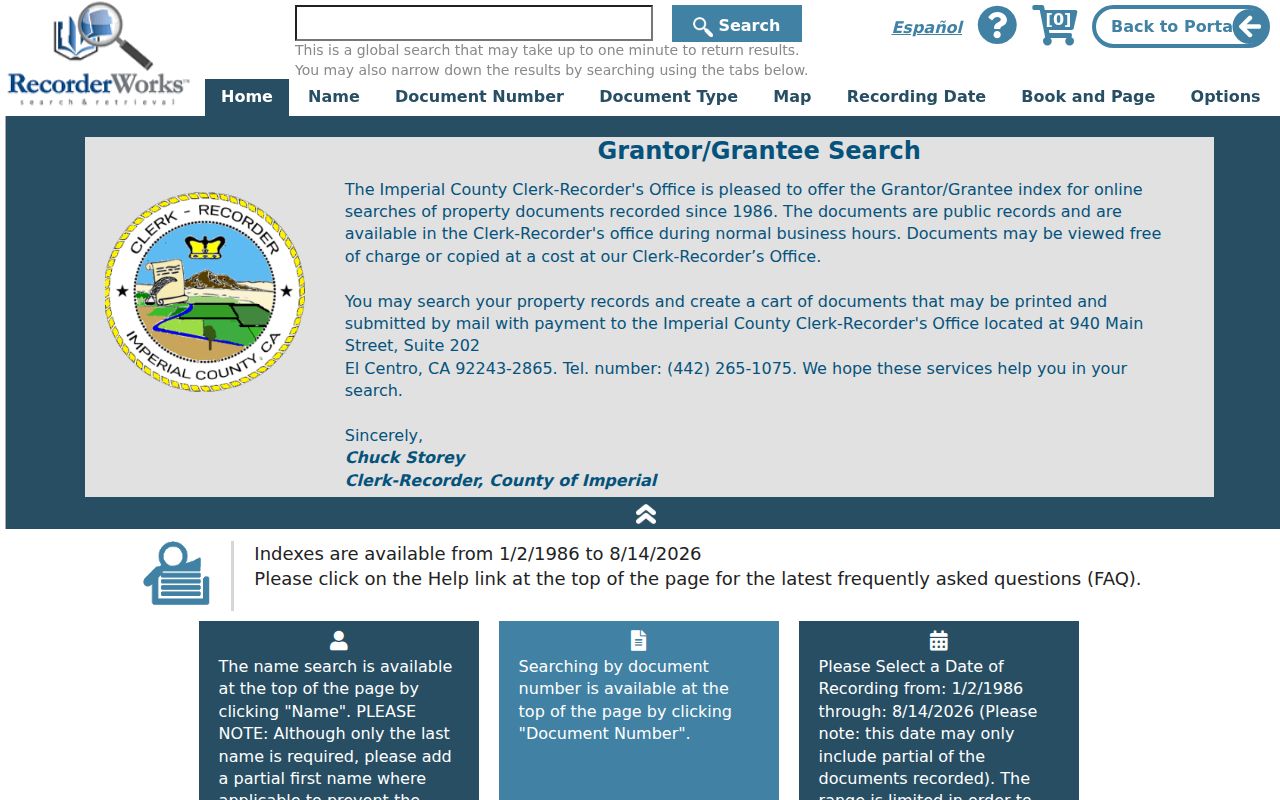
The index view is a finding aid. A copy, certification, or older instrument still belongs with the Clerk-Recorder.
| Search field | How it helps |
|---|---|
| Name | Search a person or business with surname-first syntax and optional partial match. |
| Document number | Open a known instrument using the full number and recording year. |
| Document type and dates | Narrow deeds, liens, maps, notices, probate-related instruments, and other filings. |
| Parcel number | Follow instruments tied to an APN when the parcel is known. |
| Map | Search assessor, official, record-of-survey, and other map classes. |
Note: The online RecorderWorks cutoff is a coverage boundary, not a claim that Imperial County land records began in 1986.
What Calexico ParcelQuest Proves
ParcelQuest Lite starts with the physical address or APN. The official Assessor description promises basic property characteristics and a downloadable or printable parcel map. It does not advertise an owner-name input, so begin with a known location rather than expecting a public name directory. Save the APN, situs address, legal or parcel description, and map before moving to a deed search.
Three address facts must stay separate. Situs is where the land sits. A mailing address is where tax correspondence goes and may be a post office box, a manager, a trust, or an out-of-area address. The legal description is the durable land identity used in an instrument. Neither a mailing match nor an assessment result alone proves who sleeps at the property.
Use the Assessor’s kiosk to reach the Geo Viewer. Search or locate the parcel, click its polygon, and note neighboring APNs. The viewer is a navigation aid, not a substitute for the recorder’s instrument or the assessor’s custodian record. Mapping staff can help interpret a map at (442) 265-8609 when a subdivision, split, or boundary is unclear.
To see the source behind a Calexico property search, the Imperial County Assessor’s official page explains the APN and physical-address route. The captured page is a useful reminder that the basic property search is location-led.
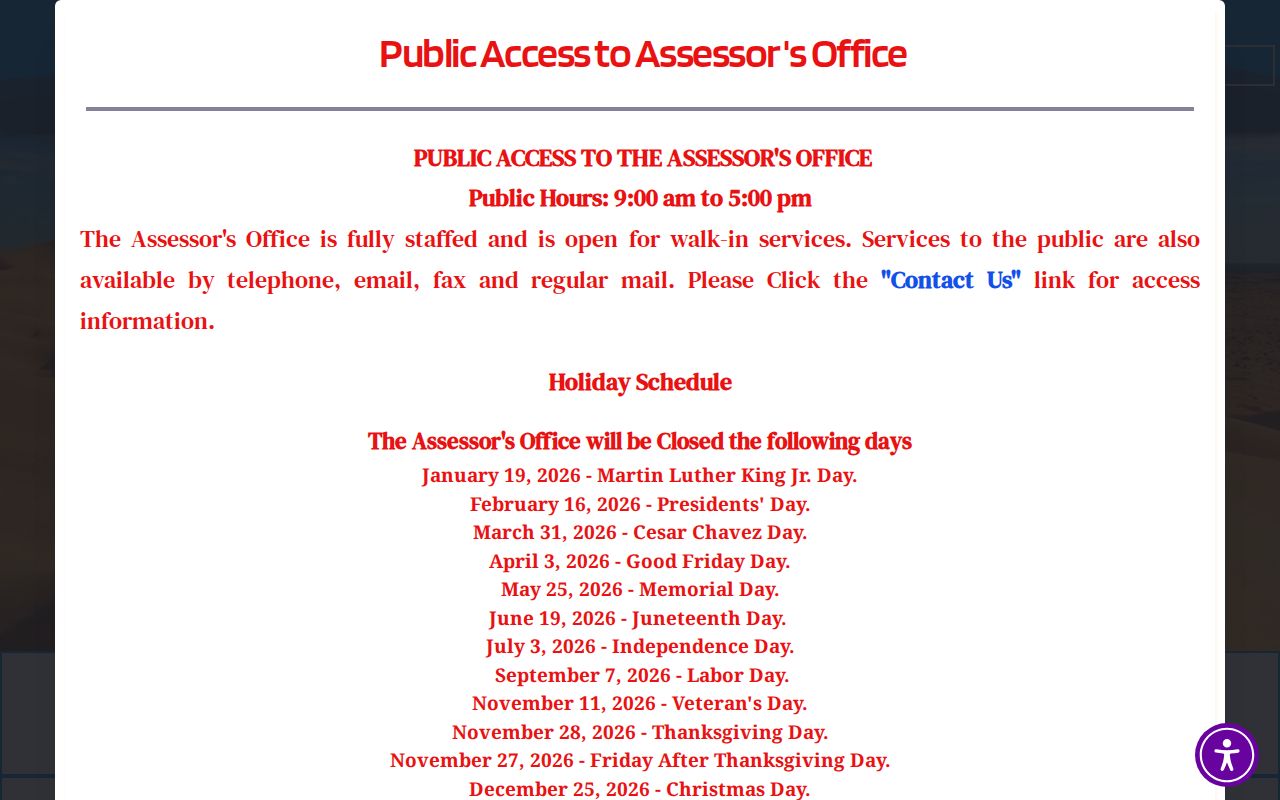
The parcel screen is best used as the first link in a chain. Record its identifier, then compare deeds, maps, permits, and dated directories instead of treating one field as a household roster.
Calexico Voter Status Is Personal
California’s My Voter Status tool helps an individual check registration, party preference, ballot status, polling information, and election details after authentication. It is not a public Calexico street roster. Elections Code section 2194 and 2 CCR sections 19001-19013 limit voter-file access to qualifying political, election, scholarly, journalistic, or governmental purposes. A casual search for another person’s address is outside that design.
Imperial County Elections can answer a person’s own registration question and supplies forms and election reports. Aggregate precinct maps, statements of vote, and district results can describe a place without naming a household. Names, residence or mailing addresses, party preference, participation history, signatures, full birth dates, and identification numbers receive different treatment. Safe at Home and protected-voter rules can remove a legitimate address from a file.
California’s 2026 AB 1392 implementation adds default confidentiality for elected officials and candidates unless they opt out. That is a current example of why absence in voter data does not establish that a person left Calexico. Use the official status tool for yourself and ask Elections about authorized file procedures when a lawful research purpose fits.
For the state tool’s own interface and access boundary, the California My Voter Status page is the correct starting point.
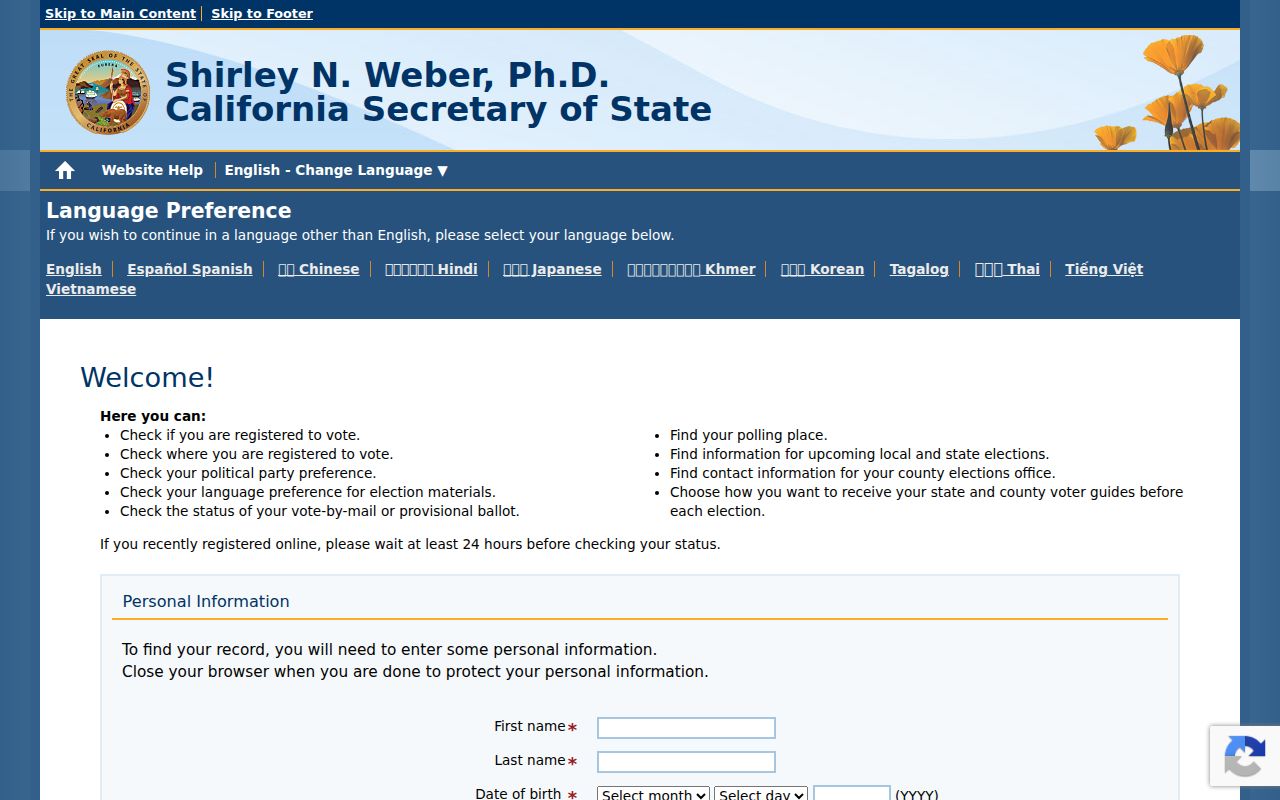
The image shows a self-check workflow, not a searchable list of Calexico residents. Keep that distinction visible when comparing records.
The Safe at Home program explains why an eligible participant may use a substitute address and why older public information is not automatically erased.
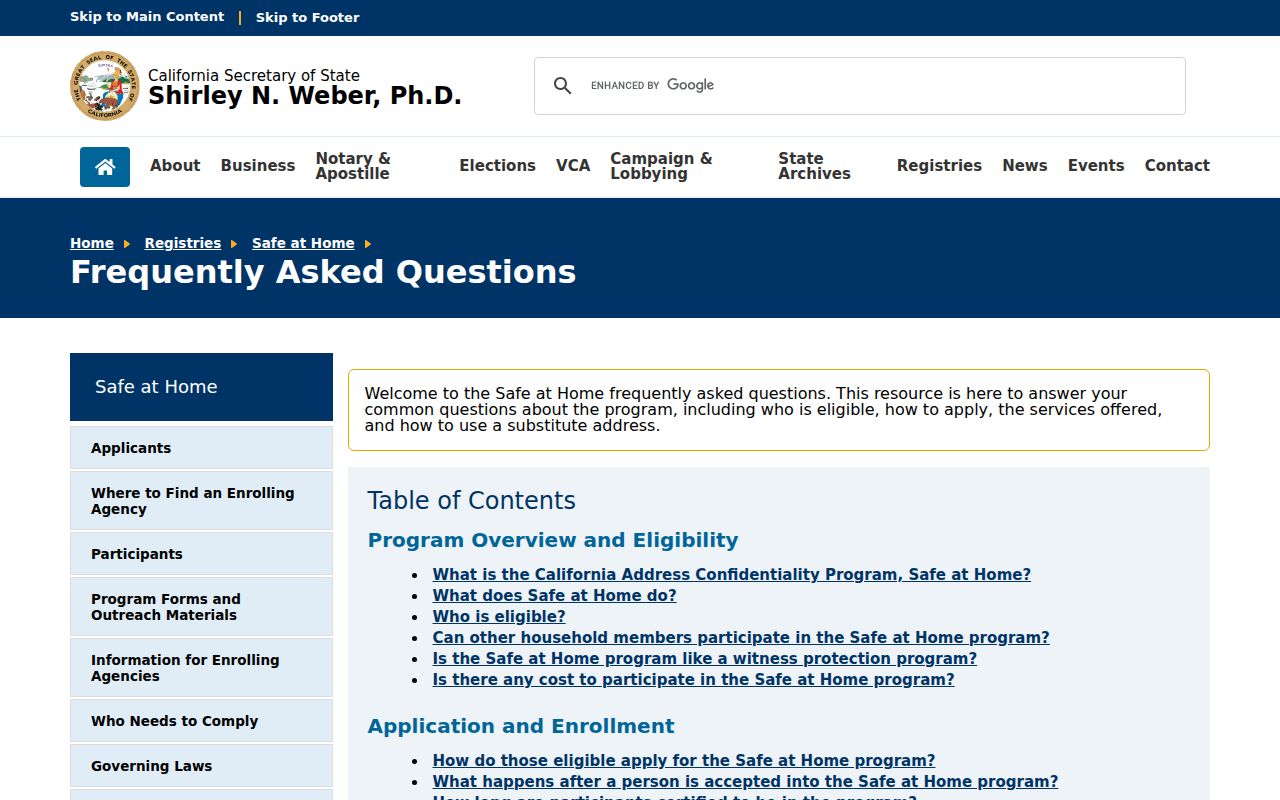
Confidentiality changes what a lawful search can show. It does not turn an absent result into evidence that a person moved.
Lawful personal use. Public records support family history, civic research, property questions, and reconnecting. Do not use a Calexico record to stalk, harass, threaten, or harm anyone.
Calexico Court Search Has Two Doors
Calexico has no separate city trial court. Imperial Superior Court serves the county through El Centro courthouses, with civil, family, and probate services at 939 W. Main Street and criminal matters at 650 Wake Avenue. The public portal supports case-number lookup, while Record Searches by Name is a separate paid clerk service. The current name-search price and year range were not exposed on the landing page, so they should be confirmed with the clerk.
Remote access is narrower than a courthouse terminal. A party who needs electronic documents may need an account, video identity verification, and a case-level token. Adoption, mental-health, juvenile, search-warrant, Ramey-warrant, sealed, and other confidential matters are not available through ordinary remote access. A missing portal result is not proof that no case exists.
The court’s online-services page shows the public lookup and paid name-search split that matters for a Calexico resident search.
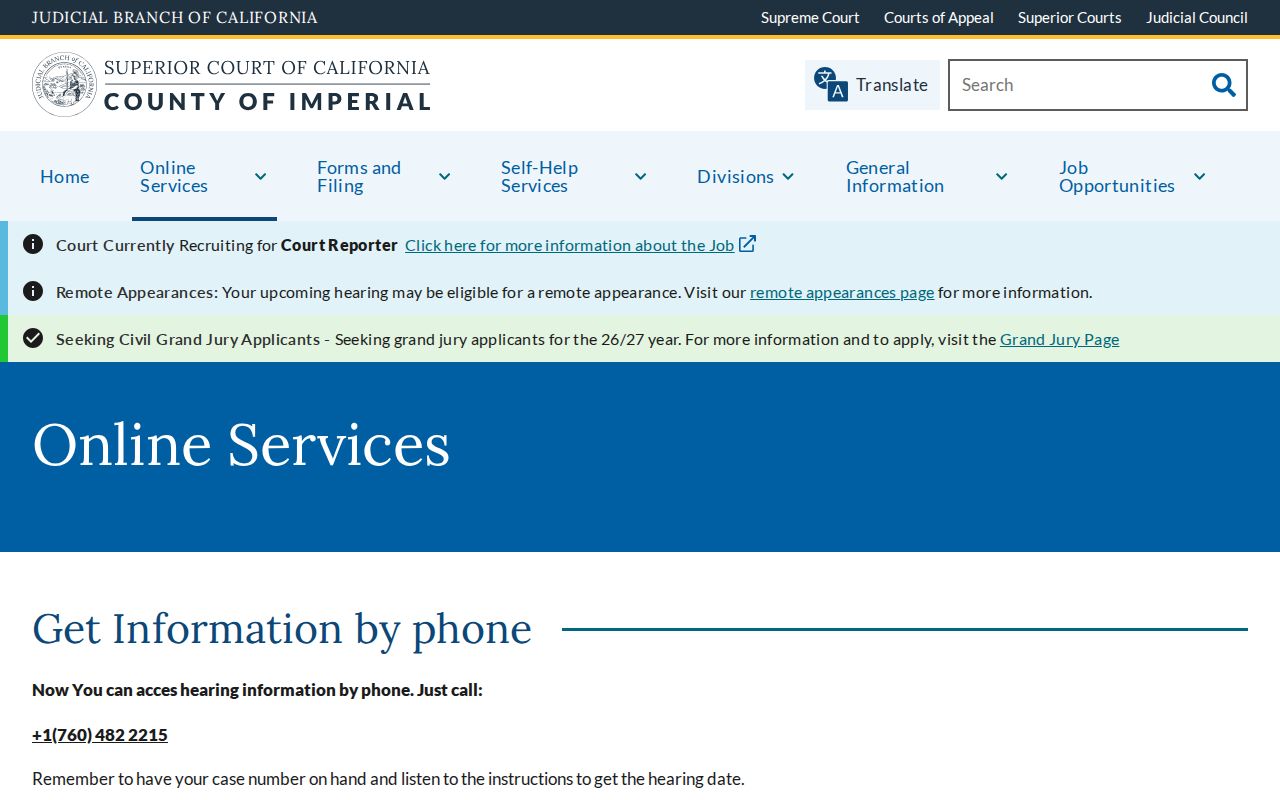
Use a case number when you have one. For a name-only question, ask the clerk about the lawful search route and any counter access.
Which Calexico Directory Source Fits
Current Calexico residents directory sources answer different questions. The Assessor is strongest for parcel identity and assessment evidence. RecorderWorks is strongest for indexed parties to recorded instruments since 1986. Elections handles a restricted voter file and a personal status check. City departments can hold permit, code, council, contract, or staff records. A court, license, or business search can add a public affiliation, but none is a complete list of households.
| Source | What It Lists | Keeper | Access |
|---|---|---|---|
| ParcelQuest Lite | APN, situs, parcel characteristics and map | Imperial County Assessor | Free basic APN/address route |
| RecorderWorks | Parties to deeds, liens, maps, notices and related instruments | Imperial County Clerk-Recorder | Free index, counter and paid copies |
| My Voter Status | One voter’s registration and election status | California Secretary of State | Authenticated self-lookup |
| City files | Applicants, correspondents, officials and project contacts | Calexico departments | Posted records or CPRA request |
| Chronicle and directories | Dated residents, businesses, notices and community activity | Archives, library and newspaper collections | Search or ask the holding institution |
The best source depends on whether the question is about land, a dated household, an official act, or a public affiliation. A resident lookup should compare dates and roles rather than merge every hit into one profile.
The Imperial County Clerk-Recorder portal shows how recorded documents, certificates, marriage services, fictitious business names, and other registrations are routed through the county office.
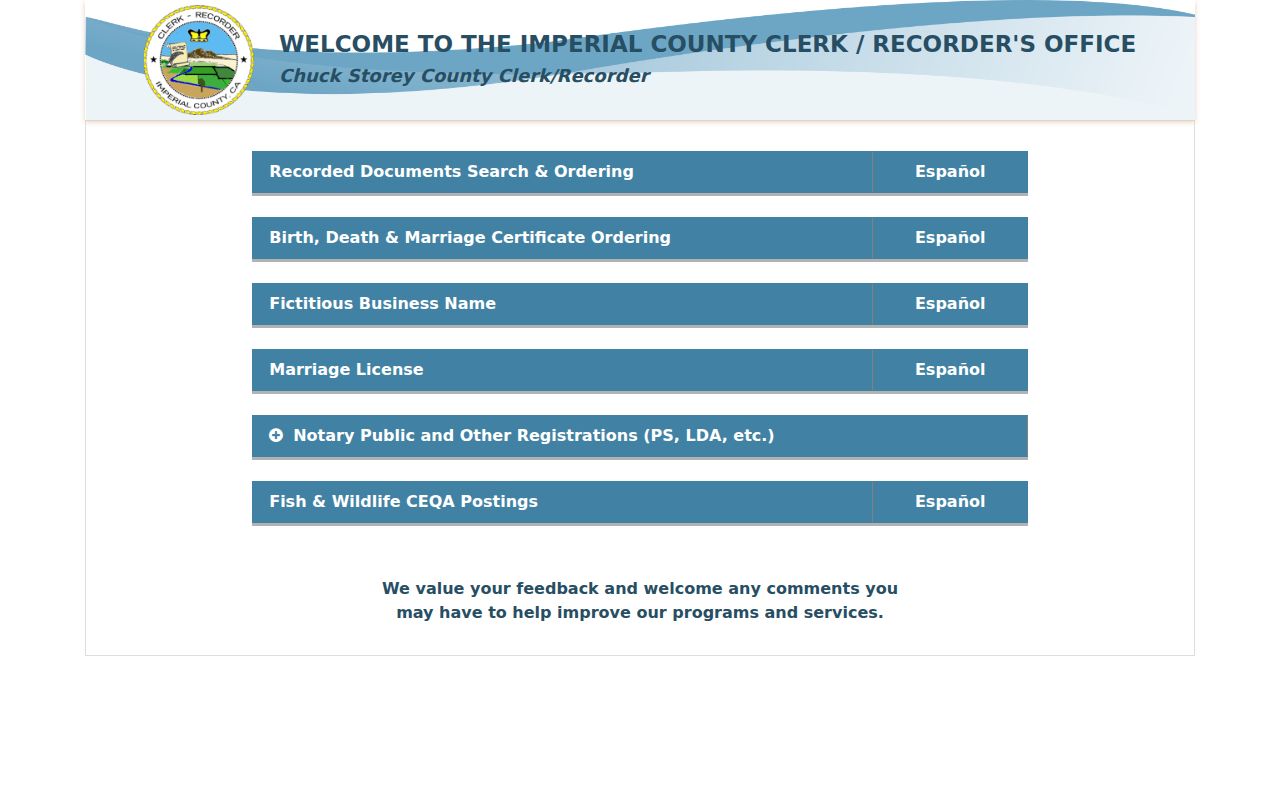
That county gateway helps separate a record request from a search for a person. The custodian and record type determine the next step.
Calexico Certificates, Indexes, Copies
Vital records require a careful distinction between an index and a certificate. Imperial County accepts an online application for local birth, death, and marriage documents, but the order is picked up and paid for in person. California Department of Public Health provides a statewide certificate route. Both channels use eligibility rules, and the available copy may be authorized or informational.
Health and Safety Code sections 102425 and 103525-103526 do not create a simple local rule in which every birth becomes open after one period and every death after another. Authorized applicants fit statutory categories and mailed requests can require a sworn statement before a notary. An informational certified copy is marked as not valid to establish identity. Historical genealogy indexes can suggest a name, county, and date, but they are not a substitute for a custodian-issued certificate.
For a divorce event, use the Superior Court judgment for the operative record. A vital-statistics certificate of record may confirm a reported event without providing the decree. For older family research, add newspapers, church registers, cemetery material, and census schedules as dated evidence.
The county’s online vital-order intake makes the pickup and payment boundary clear.
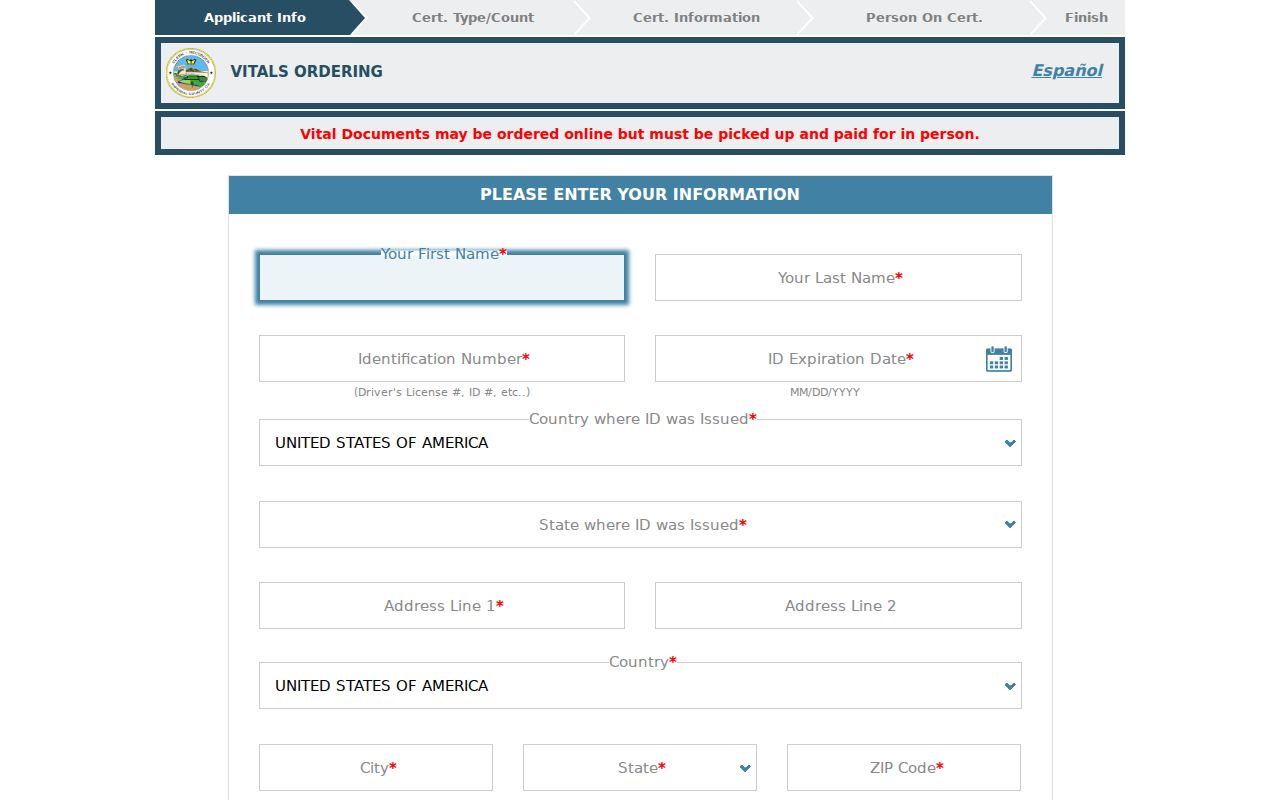
Use the form as an application start, not as a promise of online delivery or an open name search.
Calexico’s Historical Search Desk
Camarena Memorial Library is the local research desk for a Calexico residents directory search that reaches beyond current portals. It is at 850 Encinas Avenue and lists phone (760) 768-2170, fax (760) 357-0404, and library@calexico.ca.gov. Posted hours are Monday through Thursday noon to 7 p.m. and Friday 10 a.m. to 6 p.m.; it is closed on weekends. The library describes its collections and technology as reflecting Calexico’s border community.
No official holdings page confirms a full run of telephone books, criss-cross directories, Chronicle microfilm, yearbooks, obituary clippings, or Ancestry Library Edition. Ask staff to check the catalog and vertical files for “Imperial Valley city directory,” “Calexico telephone directory,” “criss-cross directory,” “Calexico Chronicle,” and a school or yearbook title. The California State Library, NARA, and the local newspaper collection provide deeper routes when a shelf is not local.
The Camarena Memorial Library branch page gives the contact details and mission that make a pre-visit catalog question worthwhile.
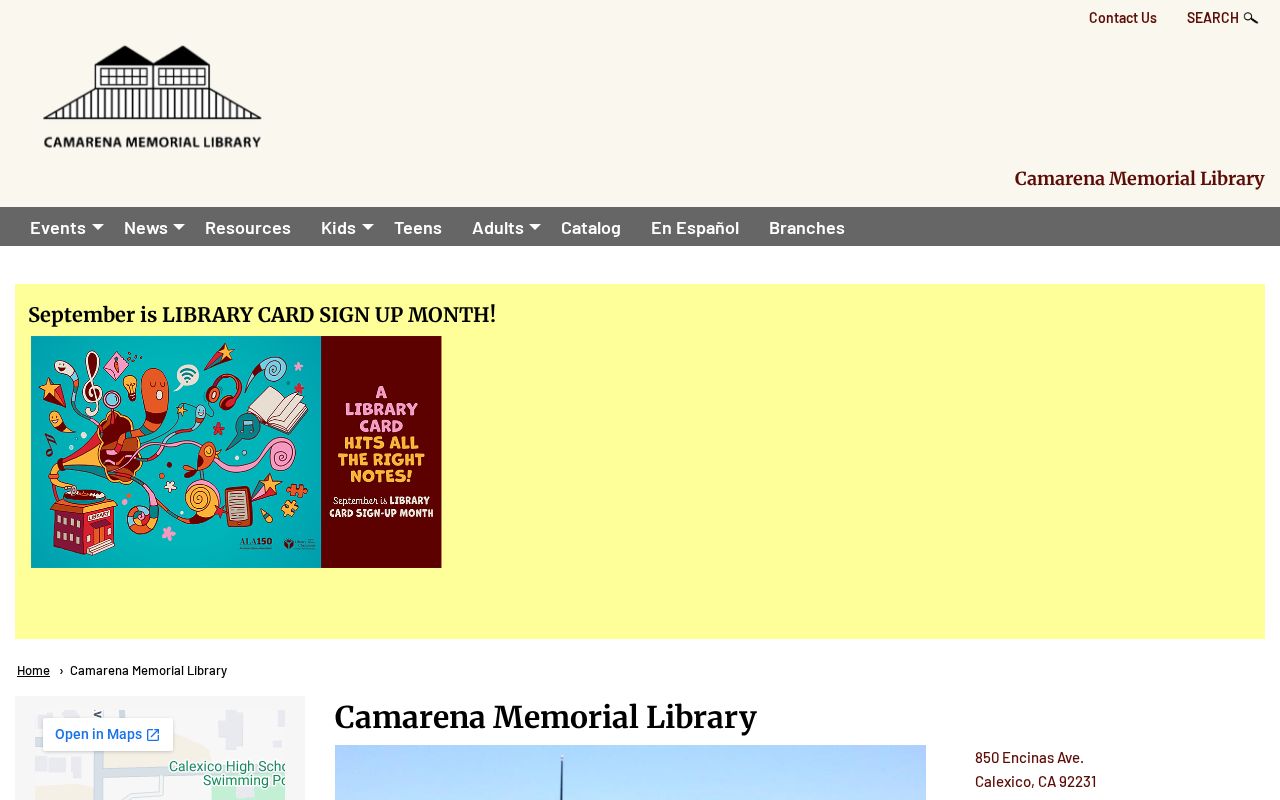
A local librarian can confirm what is actually held. That check is more reliable than assuming a generic genealogy collection includes a particular Calexico year.
Note: Ask for the exact title and years before traveling; the research record does not verify a holdings-level directory inventory.
Calexico’s 1926-to-1933 Timeline
NARA verifies four Imperial Valley directory years that include Calexico: 1926, 1928, 1930, and 1933. The volumes cover ten communities, so a search must identify the Calexico section or town marker before comparing names. The title also identifies a buyers’ guide and a complete classified business directory. A directory entry may show a surname, given name, spouse notation, occupation, address, or householder mark, but the front matter of the actual volume controls the abbreviations.
The overlap with the 1930 federal census creates a strong correction point. Record the name, address, spouse, occupation, and spelling from the 1928 volume. Compare those fields with the 1930 census, then check the 1930 and 1933 directories for a move, a changed name, or a different town marker. A blank year can mean a missed canvass, a rural route, an OCR problem, publication scope, a move, or death. It does not by itself prove that the person was absent from Calexico.
| Snapshot | What to compare | Where to start |
|---|---|---|
| 1926 and 1928 directories | Name spelling, address, spouse, occupation and town marker | NARA or catalog route |
| 1930 directory and census | Household members, age, birthplace, occupation and enumeration clues | NARA directory list and census search |
| 1933 directory | Continuation, move, business listing or changed household notation | Regional directory volume |
For the historical collection itself, the Calexico city directory page follows the volumes and reading method in greater depth.
Four Calexico Records Terms
Public record searches become clearer when the basic words stay precise. A roll is a maintained list for a defined administrative purpose. An index is a finding aid, not always the document image. A parcel is a mapped unit of land, and a criss-cross directory reverses a name list into a street-and-address view.
- Roll
- A custodian’s list, such as an assessment roll, with a defined purpose and field set.
- Index
- A set of names, dates, numbers, or descriptions that points toward an underlying record.
- Parcel
- A mapped land unit identified by an APN and legal description, which may change after a split or combination.
- Criss-cross directory
- A reverse directory arranged by street or address, when a particular collection includes that section.
These terms explain why a property result, a voter status result, and a historical directory entry should not be placed in one undifferentiated local list.
Calexico Rolls Versus Commercial Leads
Official records and commercial people-finder products serve different purposes. A county record has a custodian, a stated field set, and an access rule. A commercial product may combine public records with other data, charge for results, lag corrections, or confuse people with similar names. It can suggest a lead, but it cannot replace the original office or archive.
| Question | Official source | Commercial category |
|---|---|---|
| What land is here? | Assessor APN, map, and recorder instrument | May merge stale property data |
| Was a public filing made? | Recorder, court, city, or state custodian | May omit context or date |
| Who appeared in an earlier household? | Directory, census, Chronicle, or library collection | Often lacks page-level proof |
| Can a fact be corrected? | Contact the office that created the record | Correction may not reach the source |
Keep a copy of the source URL, record number, date, and page or result label. That trail lets a researcher explain what a hit actually says and where its limits begin.
When Calexico Online Records End
The 1986 RecorderWorks cutoff, court remote restrictions, voter authentication, and uncertain local holdings are normal stopping points. The next step is not to fill the gap with a guess. Visit the relevant counter, ask the library to check a catalog or vertical file, or submit a focused California Public Records Act request for an existing record. Name the department, record type, address or APN, date range, and preferred electronic format.
Under the California Public Records Act, an agency generally has ten calendar days to determine whether a request seeks disclosable records and can extend that determination by 14 days for unusual circumstances with written notice. The law does not require a new database or an answer to a research question. Ask for “existing records sufficient to show” the fact, such as a permit index, document list, or dated report.
- Identify the custodian and state the record type, location, and date range.
- Ask for the existing index, log, or file rather than a new list of people.
- Request electronic copies when available and separate the index from a certified copy.
- Record any exemption, redaction, or missing-year explanation for the next archive step.
Note: A focused request for an existing Calexico record is easier to answer than a request asking staff to identify everyone connected to an address.
Historical Calexico Resident Directories
The historical layer of a Calexico residents directory is a dated reconstruction, not a current list. The verified Imperial Valley volumes for 1926, 1928, 1930, and 1933 sit beside 1910-1950 census schedules, the Calexico Chronicle’s reported 1904-1998 run, Sanborn maps, and local library questions. The county’s 1907 creation from eastern San Diego County also matters for older deeds and probate. A pre-1907 chain may belong with a predecessor custodian rather than indicating a lost Calexico record.
Use names, addresses, and dates as pieces that must agree. A directory can show who was listed. A census can show a household at enumeration. A deed can show a party to a land instrument. A Sanborn sheet can show a building footprint and street context. A Chronicle notice can bridge a move, death, business, or family connection. Together they give a stronger history while preserving what each source actually proves. For the full collections workflow, use the Calexico city directory collection guide.